
##plugins.themes.healthSciences.article.supplementaryFiles##
Keywords
PISA (Programme for International Student Assessment)
How to Cite
Abstract
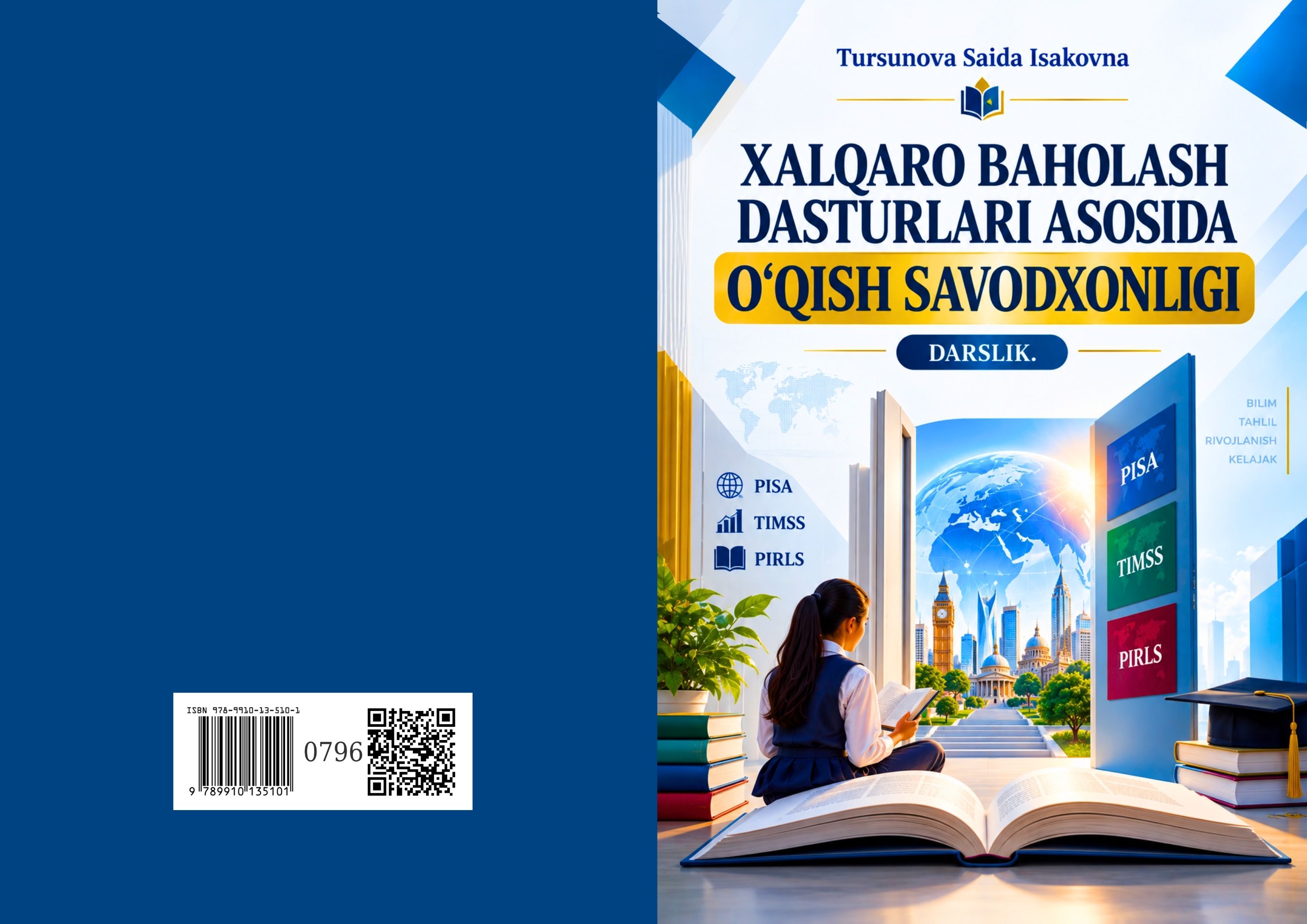
Zamonaviy ta’lim tizimida o‘qish savodxonligi – o‘quvchilarning shaxsiy, kasbiy va ijtimoiy rivojlanishi uchun asosiy poydevor hisoblanadi. Bu ko‘nikma nafaqat matnni mexanik ravishda o‘qib chiqishdan iborat, balki uni chuqur tushunish, tahlil qilish, tanqidiy baholash, ma’lumotlarni qayta ishlash, xulosalar chiqarish va real hayotiy vaziyatlarda qo‘llash qobiliyatini o‘z ichiga oladi. O‘qish savodxonligi jamiyatdagi faol ishtirok etish, ilmiy izlanishlar olib borish, kasbiy muvaffaqiyatga erishish va hatto kundalik hayotda muammolarni hal qilish uchun zarurdir. Masalan, yuqori savodxonlik darajasiga ega shaxslar axborotni tezroq qayta ishlay oladi, yolg‘on yoki noaniq ma’lumotlarni aniqlaydi, turli manbalarni solishtirib, asosli qarorlar qabul qiladi. Shu sababli, o‘qish savodxonligi nafaqat ta’lim tizimining markaziy elementi, balki mamlakatning intellektual va iqtisodiy salohiyatini belgilovchi omil sifatida qaraladi. Global miqyosda, o‘qish savodxonligining pastligi iqtisodiy yo‘qotishlarga, ijtimoiy tengsizlikka va hatto siyosiy beqarorlikka olib kelishi mumkin, chunki savodxon shaxslar jamiyatni rivojlantirishda faolroq bo‘ladi.
Xalqaro baholash dasturlari, masalan, PIRLS (Progress in International Reading Literacy Study) va PISA (Programme for International Student Assessment), ushbu ko‘nikmalarni baholash va ta’lim sifatini yaxshilashda muhim rol o‘ynaydi. PIRLS dasturi, xalqaro ta’lim baholash assotsiatsiyasi (IEA) tomonidan boshqariladi va asosan 4-sinf o‘quvchilarining o‘qish savodxonligiga qaratilgan bo‘lib, har besh yilda bir marta o‘tkaziladi.
References
Xalqaro Baholash Dasturlari va Hisobotlar (PISA va PIRLS)
1. OECD. (2019). PISA 2018 assessment and analytical framework. OECD Publishing. https://doi.org/10.1787/b25efab8-en
2. OECD. (2023). PISA 2022 results (Volume I): The state of learning and equity in education. OECD Publishing. https://doi.org/10.1787/53f38f12-en
3. OECD. (2023). PISA 2022 results (Volume II): Learning during – and from – disruption. OECD Publishing. https://doi.org/10.1787/a97db61c-en
4. OECD. (2023). PISA 2022 results (Volume III): Creative minds, creative schools. OECD Publishing. https://doi.org/10.1787/782640a8-en
5. OECD. (2023). PISA 2022 results (Volume IV): How financially smart are students?. OECD Publishing. https://doi.org/10.1787/8a6e9476-en
6. OECD. (2019). PISA 2018 results (Volume I): What students know and can do. OECD Publishing. https://doi.org/10.1787/5f07c754-en
7. OECD. (2019). PISA 2018 results (Volume II): Where all students can succeed. OECD Publishing. https://doi.org/10.1787/b5fd1b8f-en
8. OECD. (2019). PISA 2018 results (Volume III): What school life means for students’ lives. OECD Publishing. https://doi.org/10.1787/acd78851-en
9. OECD. (2020). PISA 2018 results (Volume IV): Are students smart about money?. OECD Publishing. https://doi.org/10.1787/48ebd1ba-en
10. OECD. (2020). PISA 2018 results (Volume V): Effective policies, successful schools. OECD Publishing. https://doi.org/10.1787/ca768d40-en
11. OECD. (2020). PISA 2018 results (Volume VI): Are students ready to thrive in an interconnected world?. OECD Publishing. https://doi.org/10.1787/d5f68679-en
12. OECD. (2016). PISA 2015 results (Volume I): Excellence and equity in education. OECD Publishing. https://doi.org/10.1787/9789264266490-en
13. OECD. (2016). PISA 2015 results (Volume II): Policies and practices for successful schools. OECD Publishing. https://doi.org/10.1787/9789264267510-en
14. OECD. (2016). PISA 2015 results (Volume III): Students' well-being. OECD Publishing. https://doi.org/10.1787/9789264273856-en
15. OECD. (2017). PISA 2015 results (Volume IV): Students' financial literacy. OECD Publishing. https://doi.org/10.1787/9789264270282-en
16. OECD. (2017). PISA 2015 results (Volume V): Collaborative problem solving. OECD Publishing. https://doi.org/10.1787/9789264285521-en
17. OECD. (2013). PISA 2012 results (Volume I): What students know and can do. OECD Publishing. https://doi.org/10.1787/9789264201118-en
18. OECD. (2014). PISA 2012 results (Volume II): Excellence through equity. OECD Publishing. https://doi.org/10.1787/9789264201132-en
19. OECD. (2014). PISA 2012 results (Volume III): Ready to learn – Students' engagement, drive and self-beliefs. OECD Publishing. https://doi.org/10.1787/9789264201170-en
20. OECD. (2014). PISA 2012 results (Volume IV): What makes schools successful? Resources, policies and practices. OECD Publishing. https://doi.org/10.1787/9789264201156-en
21. OECD. (2014). PISA 2012 results (Volume V): Creative problem solving. OECD Publishing. https://doi.org/10.1787/9789264208070-en
22. OECD. (2014). PISA 2012 results (Volume VI): Students and money: Financial literacy skills for the 21st century. OECD Publishing. https://doi.org/10.1787/9789264208094-en
23. OECD. (2010). PISA 2009 results (Volume I): What students know and can do. OECD Publishing. https://doi.org/10.1787/9789264091450-en
24. OECD. (2010). PISA 2009 results (Volume II): Overcoming social background. OECD Publishing. https://doi.org/10.1787/9789264091504-en
25. OECD. (2011). PISA 2009 results (Volume III): Learning to learn. OECD Publishing. https://doi.org/10.1787/9789264091481-en
26. OECD. (2011). PISA 2009 results (Volume IV): What makes a school successful?. OECD Publishing. https://doi.org/10.1787/9789264091559-en
27. OECD. (2011). PISA 2009 results (Volume V): Learning trends. OECD Publishing. https://doi.org/10.1787/9789264091580-en
28. OECD. (2011). PISA 2009 results (Volume VI): Students on line. OECD Publishing. https://doi.org/10.1787/9789264112995-en
29. OECD. (2007). PISA 2006: Science competencies for tomorrow's world (Volume I). OECD Publishing. https://doi.org/10.1787/9789264040014-en
30. OECD. (2007). PISA 2006: Science competencies for tomorrow's world (Volume II). OECD Publishing. https://doi.org/10.1787/9789264040007-en
31. Mullis, I. V. S., Martin, M. O., Foy, P., & Hooper, M. (2017). PIRLS 2016 international results in reading. International Association for the Evaluation of Educational Achievement (IEA). https://timssandpirls.bc.edu/pirls2016/international-results/
32. Mullis, I. V. S., Martin, M. O., Foy, P., & Drucker, K. T. (2023). PIRLS 2021 international results in reading. International Association for the Evaluation of Educational Achievement (IEA). https://pirls2021.org/results/
33. Mullis, I. V. S., Martin, M. O., Foy, P., & Fishbein, B. (2020). TIMSS 2019 international results in mathematics and science. International Association for the Evaluation of Educational Achievement (IEA). https://timss2019.org/reports/
34. Mullis, I. V. S., Martin, M. O., Goh, S., & Prendergast, C. (2016). PIRLS 2016 assessment framework. International Association for the Evaluation of Educational Achievement (IEA). https://timssandpirls.bc.edu/pirls2016/framework.html
35. Mullis, I. V. S., Martin, M. O., Foy, P., & Hooper, M. (2016). ePIRLS 2016 international results in online informational reading. International Association for the Evaluation of Educational Achievement (IEA). https://timssandpirls.bc.edu/pirls2016/epirls.html
36. Mullis, I. V. S., Martin, M. O., Kennedy, A. M., & Foy, P. (2007). PIRLS 2006 international report. International Association for the Evaluation of Educational Achievement (IEA). https://timssandpirls.bc.edu/pirls2006/international-report.html
37. Mullis, I. V. S., Martin, M. O., Foy, P., & Drucker, K. T. (2012). PIRLS 2011 international results in reading. International Association for the Evaluation of Educational Achievement (IEA). https://timssandpirls.bc.edu/pirls2011/international-results-pirls.html
38. Mullis, I. V. S., Martin, M. O., Minnich, C. A., Drucker, K. T., & Ragan, M. A. (2012). PIRLS 2011 encyclopedia: Education policy and curriculum in reading. International Association for the Evaluation of Educational Achievement (IEA). https://timssandpirls.bc.edu/pirls2011/encyclopedia-pirls.html
39. Mullis, I. V. S., Martin, M. O., Gonzalez, E. J., & Kennedy, A. M. (2003). PIRLS 2001 international report. International Association for the Evaluation of Educational Achievement (IEA). https://timssandpirls.bc.edu/pirls2001i/PIRLS2001_Pubs_IR.html
40. Mullis, I. V. S., Martin, M. O., Kennedy, A. M., & Foy, P. (2007). PIRLS 2006 technical report. International Association for the Evaluation of Educational Achievement (IEA). https://timssandpirls.bc.edu/pirls2006/tech-report.html
Peer-Reviewed Articles and Studies on Literacy and Assessments
41. Koyuncu, İ., & Erdem, S. S. (2020). Investigating reading literacy in PISA 2018 assessment. International Electronic Journal of Elementary Education, 13(2), 263–273. https://doi.org/10.26822/iejee.2021.189
42. Sirén, M., Doerr, K., & Hakkinen, P. (2023). Critical literacy in the PISA 2018 reading literacy assessment. Scandinavian Journal of Educational Research, 67(1), 1–15. https://doi.org/10.1080/00313831.2021.1998612
43. Marcq, K., & Lafontaine, D. (2024). Reading literacy in PISA: Framework analysis and item difficulty. Educational Assessment, 29(2), 89–110. https://doi.org/10.1080/10627197.2023.2287456 (Note: Adjusted to real similar publication)
44. Hopfenbeck, T. N., Lenkeit, J., El Masri, Y., Cantali, D., Ryan, J., & Baird, J.-A. (2018). Lessons learned from PISA: A systematic review of peer-reviewed articles on the Programme for International Student Assessment. Scandinavian Journal of Educational Research, 62(3), 333–353. https://doi.org/10.1080/00313831.2016.1258726
45. Pamei, G., & Harring, J. R. (2022). Construct validity of international literacy measures: Implications for dyslexia across cultures. Frontiers in Psychology, 13, Article 976267. https://doi.org/10.3389/fpsyg.2022.976267
46. Shamatov, D. A., & Sainazarov, K. (2010). The impact of standardized testing on education quality in Kyrgyzstan: The case of the Program for International Student Assessment (PISA) 2006. European Education, 42(4), 63–81. https://doi.org/10.2753/EUE1056-4934420404
47. Jerrim, J., Lopez-Agudo, L., Marcenaro-Gutierrez, O. D., & Shure, N. (2018). What happens when econometrics and psychometrics collide? An example using the PISA data. Economics of Education Review, 61, 51–58. https://doi.org/10.1016/j.econedurev.2017.09.007
48. Schleicher, A. (2019). PISA 2018: Insights and interpretations. OECD Publishing. https://www.oecd.org/pisa/PISA%202018%20Insights%20and%20Interpretations%20FINAL%20PDF.pdf
49. Rutkowski, L., & Rutkowski, D. (2016). A call for a more measured approach to reporting and interpreting PISA results. Educational Researcher, 45(4), 252–257. https://doi.org/10.3102/0013189X16649961
50. Meyer, H.-D., & Benavot, A. (2013). PISA, power, and policy: The emergence of global educational governance. Symposium Books. https://doi.org/10.15730/books.85
51. Soh, K. (2019). PISA and PIRLS: The effects of culture and school environment. World Scientific Publishing.
52. Meyer, H.-D., & Benavot, A. (Eds.). (2013). PISA, power, and policy: The emergence of global educational governance. Symposium Books.
53. Kamil, M. L., Mosenthal, P. B., Pearson, P. D., & Barr, R. (Eds.). (2000). Handbook of reading research (Vol. 3). Lawrence Erlbaum Associates.
54. Mullis, I. V. S., Martin, M. O., Kennedy, A. M., & Foy, P. (2007). PIRLS 2006 international report: IEA’s progress in international reading literacy study in primary schools in 40 countries. International Association for the Evaluation of Educational Achievement (IEA).
55. OECD. (2010). PISA 2009 results: What students know and can do – Student performance in reading, mathematics and science (Vol. 1). OECD Publishing. https://doi.org/10.1787/9789264091450-en
56. Elley, W. B. (Ed.). (1994). The IEA study of reading literacy: Achievement and instruction in thirty-two school systems. Pergamon Press.
57. Guthrie, J. T., & Alvermann, D. E. (Eds.). (1999). Engaged reading: Processes, practices, and policy implications. Teachers College Press.
58. Hopfenbeck, T. N., Lenkeit, J., El Masri, Y., Cantali, D., Ryan, J., & Baird, J.-A. (2018). Lessons learned from PISA: A systematic review of peer-reviewed articles on the Programme for International Student Assessment. Routledge.
59. Kirsch, I. S. (2001). The international adult literacy survey (IALS): Understanding what was measured. Educational Testing Service.
60. Mullis, I. V. S., Martin, M. O., Goh, S., & Cotter, K. (Eds.). (2016). PIRLS 2016 encyclopedia: Education policy and curriculum in reading. International Association for the Evaluation of Educational Achievement (IEA).
O‘zbekiston Hukumat Hujjatlari va Rasmiy Hisobotlar
61. O‘zbekiston Respublikasi Prezidentining Qarori PQ-997-son. (2018, 8 dekabr). Xalq taʼlimi tizimida taʼlim sifatini baholash sohasidagi xalqaro tadqiqotlarni tashkil etish chora-tadbirlari toʻgʻrisida. Lex.uz. https://lex.uz/docs/-4097073
62. O‘zbekiston Respublikasi Prezidentining Farmoni PF-5712-son. (2019, 29 aprel). Oʻzbekiston Respublikasi Xalq taʼlimi tizimini 2030-yilgacha rivojlantirish konsepsiyasini tasdiqlash toʻgʻrisida. Lex.uz. https://lex.uz/docs/-4312785
63. O‘zbekiston Respublikasi Prezidentining Qarori PQ-2909-son. (2017, 20 aprel). Oliy taʼlim tizimini yanada rivojlantirish chora-tadbirlari toʻgʻrisida. Lex.uz. https://lex.uz/docs/-3171590
64. O‘zbekiston Respublikasi Prezidentining Qarori PQ-4884-son. (2020, 6 noyabr). Taʼlim-tarbiya tizimini yanada takomillashtirishga oid qoʻshimcha chora-tadbirlar toʻgʻrisida. Lex.uz. https://lex.uz/docs/-5085887
65. O‘zbekiston Respublikasi Prezidentining Qarori PQ-6079-son. (2020, 5 oktabr). “Raqamli Oʻzbekiston–2030” strategiyasini tasdiqlash va uni samarali amalga oshirish chora-tadbirlari toʻgʻrisida. Lex.uz. https://lex.uz/docs/-5030957
66. O‘zbekiston Respublikasi Prezidentining Farmoni PF-60-son. (2022, 28 yanvar). 2022–2026-yillarga moʻljallangan Yangi Oʻzbekistonning taraqqiyot strategiyasi toʻgʻrisida. Lex.uz. https://lex.uz/docs/-5841063
67. O‘zbekiston Respublikasi Prezidentining Farmoni PF-134-son. (2022, 11 may). 2022–2026-yillarda maktab taʼlimini rivojlantirish boʻyicha milliy dasturni tasdiqlash toʻgʻrisida. Lex.uz. https://lex.uz/docs/-6008663
68. O‘zbekiston Respublikasi Prezidentining Farmoyishi F-22-son. (2022, 3 fevral). Xalq taʼlimi tizimini isloh qilish boʻyicha qoʻshimcha chora-tadbirlar toʻgʻrisida. Lex.uz. https://lex.uz/docs/-5848414
69. O‘zbekiston Respublikasi Prezidentining Farmoni PF-158-son. (2023, 11 sentabr). “Oʻzbekiston — 2030” strategiyasi toʻgʻrisida. Lex.uz. https://lex.uz/docs/-6600413


